
CoachingKhojo guide

Written by
CoachingKhojo Team
Updated on:
25/05/2026
The Indian Administrative Service (IAS) is often called the "Steel Frame of India." It is a career that offers an unmatched combination of power, prestige, and the opportunity to serve the public. However, the path to reaching this goal is long and requires a disciplined approach.
If you are aiming for the 2027 Civil Services Examination (CSE), you have a significant advantage: time. With roughly a year and a half to prepare, you can build a foundation that is much stronger than those who start at the last minute. This guide will walk you through every technical detail, eligibility rule, and preparation strategy you need.
The Union Public Service Commission (UPSC) is the central agency in India authorised to conduct the Civil Services Examination. While most people refer to it as the "IAS Exam," it is actually a single examination used to recruit officers for more than 20 government services.
When you fill out your application, you provide a "preference list." Depending on your final rank and the number of vacancies, you are allocated to one of these services:
Success in UPSC starts with marking your calendar. While the Commission will release the official calendar for 2027 in late 2026, we can project the dates based on the traditional UPSC schedule.
| Milestone | Expected Timeline |
| Official Notification Release | Early February 2027 |
| Registration Window | Feb 2027 – March 2027 |
| Admit Card for Prelims | Early May 2027 |
| Preliminary Examination | Last Sunday of May 2027 |
| Mains Examination | September 2027 |
| Personality Test (Interview) | Jan – March 2028 |
| Final Selection List | May 2028 |
UPSC has strict rules regarding who can apply. It is vital to check these before you invest your time and money into preparation.
To be an IAS or IPS officer, you must be a citizen of India. For other services (like IFS or IRS), candidates from certain other countries (like Nepal or Bhutan) may be eligible under specific government conditions.
Top Blogs
You must have a degree from a recognised university.
The minimum age to apply is 21 years. The upper age limit varies by category:
| Category | Age Limit (Including Relaxation) | Maximum Attempts |
|---|---|---|
| General / EWS | 21–32 Years | 6 attempts |
| OBC | Up to 35 Years (3-year relaxation) | 9 attempts |
| SC / ST | Up to 37 Years (5-year relaxation) | Unlimited (within age limit) |
| PwBD | Up to 42 Years (10-year relaxation) | General/OBC: 9 attempts |
| PwBD (SC/ST) | Up to 42 Years | Unlimited (within age limit) |
The UPSC selection process is designed to be a "rejection" process rather than just a selection process. It slowly filters out millions of candidates to find the top 1,000.
The Prelims are a qualifying stage. The marks you get here are not counted in your final rank, but you must pass to reach the next stage. It consists of two objective-type papers:
This is where the real competition begins. The Mains is a descriptive exam. You have to write long-form answers to show your depth of understanding.
If you clear the Mains cutoff, you are invited to the UPSC Bhawan in New Delhi. A board of high-ranking officials and psychologists will talk to you for 30 minutes. They want to see if you have the "officer-like qualities" (OLQs) such as integrity, mental alertness, and balanced judgment.
UPSC Civil Services Exam Pattern 2027 follows a three-stage selection process designed to test a candidate’s knowledge, analytical ability, writing skills, and personality traits required for top administrative roles.
The UPSC Prelims Exam Pattern consists of two objective-type papers, conducted on the same day. This stage acts as a screening test for the Mains.
| Paper | Subject | Nature | Questions | Duration | Marks |
|---|---|---|---|---|---|
| Paper I | General Studies | Merit-based | 100 | 2 Hours | 200 |
| Paper II | CSAT | Qualifying | 80 | 2 Hours | 200 |
The UPSC Mains Exam 2027 is a descriptive test consisting of 9 papers, each of 3 hours duration. It evaluates depth of understanding and written expression.
| Paper | Subject | Time | Type of Questions |
Marks |
|---|---|---|---|---|
| Paper 1 | Indian Language (Qualifying) | 3 hours | Descriptive | 300 |
| Paper 2 | English (Qualifying) | 3 hours | Descriptive | 300 |
| Paper 3 | Essay | 3 hours | Descriptive | 250 |
| Paper 4 | GS I | 3 hours | Descriptive | 250 |
| Paper 5 | GS II | 3 hours | Descriptive | 250 |
| Paper 6 | GS III | 3 hours | Descriptive | 250 |
| Paper 7 | GS IV | 3 hours | Descriptive | 250 |
| Paper 8 | Optional Paper I | 3 hours | Descriptive | 250 |
| Paper 9 | Optional Paper II | 3 hours | Descriptive | 250 |
The UPSC Interview 2026 is the final stage and carries 275 marks. There is no fixed syllabus, as the board assesses personality traits such as leadership, integrity, decision-making, and suitability for civil services.
| Level | Paper | Marks | Type of Questions | Total |
| Prelims | GS I + CSAT | 200 + 200 | Objective | 400 (Qualifying) |
| Mains | Essay | 250 | Descriptive | 1750 (Merit) |
| GS I, II, III, IV | 250 each (1000 total) | |||
| Optional I & II | 250 each (500 total) | |||
| Interview | Personality Test | 275 | Personality Test | 275 (Merit) |
| Grand Total (Mains + Interview) |
2025 Marks | |||
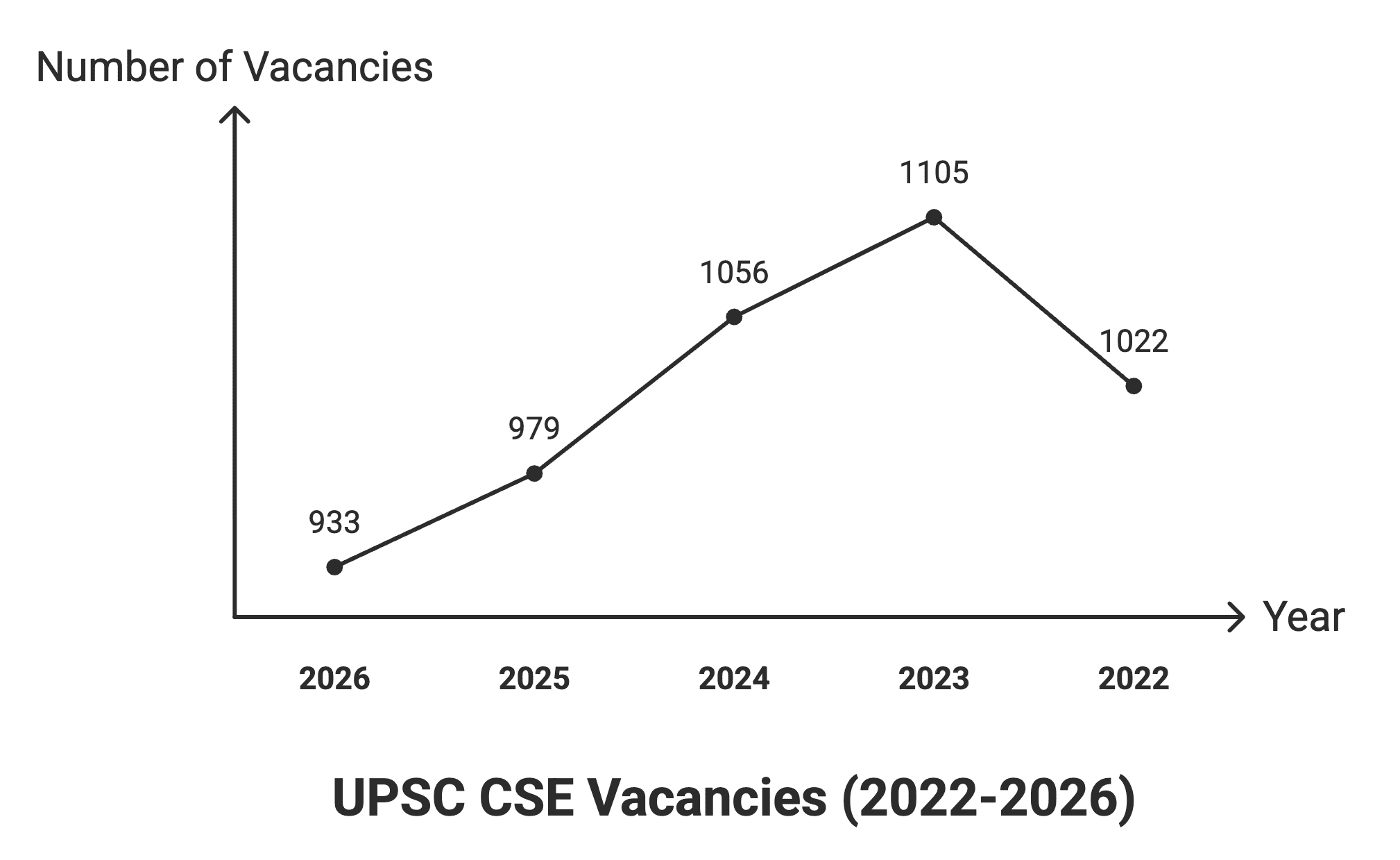
| Year | Total UPSC CSE Vacancies |
|---|---|
| UPSC 2026 | 933 |
| UPSC 2025 | 979 |
| UPSC 2024 | 1,056 |
| UPSC 2023 | 1,105 |
| UPSC 2022 | 1,022 |
The UPSC syllabus is often described as "everything under the sun," but that is an exaggeration. The syllabus is actually very structured.
| Paper | Subjects / Topics |
|---|---|
| General Studies Paper I | Current Affairs (National & International), History of India & Indian National Movement, Indian & World Geography, Indian Polity & Governance, Economic & Social Development, Environment, Ecology & Climate Change, General Science |
| CSAT Paper II (Qualifying) | Comprehension, Interpersonal & Communication Skills, Logical Reasoning & Analytical Ability, Decision Making & Problem Solving, Basic Numeracy (Class X level), Data Interpretation |
| Paper | Syllabus Topics |
|---|---|
| Essay | Essay writing on multiple topics of national and international relevance |
| General Studies I | Indian Heritage & Culture, History, World History, Indian & World Geography |
| General Studies II | Constitution, Polity, Governance, Social Justice, International Relations |
| General Studies III | Indian Economy, Agriculture, Science & Technology, Environment, Disaster Management, Internal Security |
| General Studies IV | Ethics, Integrity, Aptitude, Case Studies |
| Optional Subject | One optional subject chosen by the candidate (Paper I & II) |
The Optional Subject carries 500 marks, which can make or break your selection. Many candidates pick a subject they studied in college, while others pick "high-scoring" subjects like Sociology, Geography, or Public Administration.
| Agriculture | Animal Husbandry & Veterinary Science | Anthropology |
| Botany | Chemistry | Civil Engineering |
| Commerce & Accountancy | Economics | Electrical Engineering |
| Geography | Geology | History |
| Law | Management | Mathematics |
| Mechanical Engineering | Medical Science | Philosophy |
| Physics | Political Science & International Relations | Psychology |
| Public Administration | Sociology | Statistics |
| Zoology | ||
Joining the IAS is not just about the starting salary; it is about the career trajectory.
IAS officers receive a government bungalow, a fleet of vehicles, domestic staff, and medical benefits that cover their entire family. More importantly, they have the power to sign orders that can change the lives of millions.
If you are starting now for 2027, here is a suggested timeline:
The UPSC CSE 2027 is a marathon. It is not about who is the smartest, but who is the most consistent. You will have days when you want to quit, but remember why you started.
Focus on the process, stay curious about the world, and keep your goal in sight. With a solid plan and a year of hard work, you could be the one walking into the Lal Bahadur Shastri National Academy of Administration (LBSNAA) in 2028.
| Institute Name | Mode of class | Fees | Best For | City |
| Vision IAS | Online, Classroom | ₹2,48,500 | Best for Test Series | 12+ Centre |
| Vajiram & Ravi | Online, Classroom | ₹1,75,000 | Best for English medium Students | Delhi, Chennai |
| Drishti IAS | Online, Classroom | ₹1,70,000 | Best for Hindi medium Students | Delhi, Patna, Lucknow, Indore |
| Rau's IAS | Online, Classroom | ₹1,75,000 | 70-year legacy | Delhi, Bangalore |
| Forum IAS | Online, Classroom |
₹ 153400.00 |
Specialising in mains answer writing (MGP) | Delhi, Patna |
| NEXT IAS | Online, Classroom | ₹ 1,47,457 + GST | Best for English medium Students | Delhi, Jaipur |
| PW Only IAS | Online, Classroom | ₹ 47,200 | Affordable Fee | Delhi, Patna, Lucknow, Indore |
| ClearIAS | Online, Classroom | ₹1,09,999 | Best For Online & Mentorship Course | Thiruvananthapuram |
| Chahal Academy | Online, Classroom | ₹1,49,000 | Best for Affordable Fee | Delhi, Gujarat |